

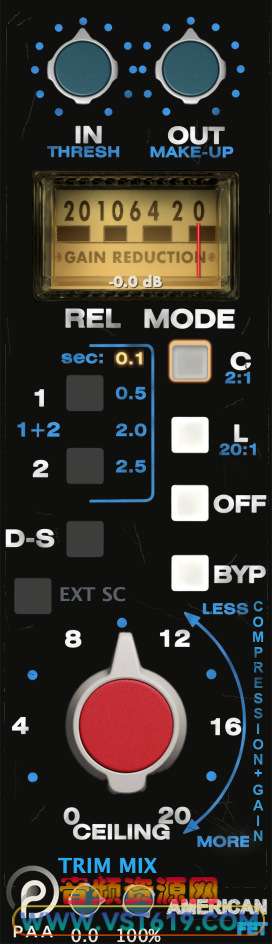
压缩器插件PAA Audio American FET
VST插件格式:
VST3/AAX
PAA Audio American FET复刻美式500系列FET压缩器,采用PCCN实时电路建模,单旋钮CEILING控制,支持压缩/限幅/纯染色模式,带侧链滤波、并联压缩、变压器饱和质感。
翻译:
American FET
这款 500 系列 FET 压缩器,正是赋予美式唱片那种“干脆利落感”(snap)的利器。
- 出厂时,每一台设备都经过了严格测量,并记录了各项固定读数,以此作为合格与否的判定标准。American FET 严格参照这些数据进行了校准,确保在“压缩”(Compress)和“限制”(Limit)模式下,所有六项电平读数均完全吻合。
- 先试听,再决定是否购买。请查看下方内容:同一段音频素材在插件“启用”与“旁通”(关闭)状态下的对比。我们已对电平进行了匹配,确保不会因音量差异而产生误导。您可以自由切换,亲自判断。
- 单旋钮操控。通过“CEILING”(上限)旋钮即可调节压缩力度,同时自动补偿输出电平——即使大幅增加压缩量,最终输出电平依然保持不变。
- 即使关闭压缩功能,依然能获得音色渲染。在“MODE OFF”(关闭模式)下,音频信号仍会经过分立式放大电路和变压器,为无需压缩的音轨增添如同大型调音台般的厚重质感。
- 信号在流经电路时,内部元件实时协同工作:JFET 在其真实的特性曲线上运作,分立式运算放大器作为晶体管级发挥作用,变压器则贡献了其独特的铁芯音色。
它的响应速度极快。JFET 负责增益控制,能在瞬态信号结束前迅速介入;后端的“分立式运放”则在压缩过程中注入独特的音色。用在房间拾音麦克风(room mic)上,能将空间距离感转化为厚重的质感;用在军鼓上,能精准捕捉到鼓棒敲击的质感;用在人声上,它能稳稳地控制动态,却又听不出任何生硬的压缩痕迹。
这种设计之所以能长盛不衰,即便在已经拥有三台其他压缩器的机架中依然占有一席之地,是有原因的。它追求的绝非“隐形”的细微处理。经过它处理的鼓组,听起来就像是成品唱片中的声音,而非原始录音室素材;这种质感无需反复对比,即便隔着房间也能清晰可辨。
深入元件细节
- “CEILING”旋钮的每一档位,都对应电路图中的电阻阶梯网络。每档步进为 2 dB,这是基于实际元件测量得出的,而非仅仅套用某种理论曲线。
- “D-S”(去齿音/侧链)滤波器同样源自电路图中的开关网络。它包含了一个常被忽略的细节:在提升高频的同时,它也会提升深沉的低频。
*输出变压器采用了与原始硬件相同的型号,并基于其真实的铁芯特性进行建模。当输入信号较强时,它会产生饱和效应,而非仅仅是音量变大。
*检测器(Detector)能够在采样点之间重建峰值(频率约为 380 kHz,不受工程采样率影响),从而捕捉到那些普通数字检测器容易遗漏的短促瞬态信号。
所有技术细节均有记录,包括模型与实际硬件测量结果之间仍存在的差异之处。
无压缩的音色渲染
将模式(MODE)切换至“OFF”时,增益控制单元(Gain Cell)便不再参与工作,但分立式输出放大器和变压器依然保持在信号路径中。此时,“OUT”旋钮不再是单纯的补偿增益(Make-up Gain),而是变成了驱动控制(Drive Control)——你可以加大“OUT”的驱动量,随后通过“TRIM”旋钮进行反向调节,将输出电平控制在理想范围内。
对于动态较小的音源,该信号路径能保持纯净;若输入信号较强并加大“OUT”驱动,变压器便开始发挥作用——产生以三次谐波为主(远强于二次谐波)的饱和效果,这正是推挽式(Push-Pull)输出级饱和的典型特征。即使在完全不需要压缩的音轨上,它也能赋予声音那种“调音台特有的厚重感”。大多数压缩器往往让你在“压缩”与“音色渲染”之间二选一,而这款设备则无需取舍。
功能特性
*四种模式:C(2:1 压缩,处理方式温和透明)、L(20:1 限制,彻底锁定电平)、OFF(仅保留放大器与变压器,不进行动态处理)、BYP(真实旁通)。
*“CEILING”是压缩功能中唯一的控制旋钮,只需旋转它,即可从轻微的几 dB 压缩平滑过渡到极致的限制效果。
*面板提供四种释放时间(Release Time)选项,从 0.1 秒的快速响应到 2.5 秒的平滑粘合感(Glue)。
*“D-S”功能可将检测器的频响重心向高频倾斜;在处理人声时,它可作为去齿音器(De-esser)使用,无需额外加载插件。
*支持外部侧链(Sidechain)、双声道/立体声联动/单声道模式;具备干湿比(Dry/Wet)混合功能,方便进行并行处理;另设有变压器后的“TRIM”旋钮,让你在驱动变压器的同时,依然能精确控制输出电平。
*电平表下方设有峰值保持(Peak-hold)显示,让你直观地看到实际被压缩掉的电平量。
PCCN™ 的独特之处:
传统的 DSP(数字信号处理)技术模拟的是“结果”——即固定的饱和曲线、脉冲响应,或是对设备在某一特定状态下表现的“神经捕捉”(Neural Capture)。而 PCCN 模拟的是“成因”:当音频信号流经电路时,系统会实时计算电路的运行状态。这种方式呈现出的听感,是单纯依靠曲线模拟所无法企及的。例如,检测电路中的整流器会自然产生“拐点”(knee);当增益控制单元(gain cell)达到工作极限时,压缩比会随之陡增;而当输出端被强力驱动时,变压器会先于放大器做出动态响应。
原文:
American FET
The 500-series FET compressor that put the snap in American records.
*The factory measured every single one before it shipped. Fixed readings, pass or fail. American FET is calibrated against that same list and hits all six level readings, in Compress and in Limit.
*Hear it before you pay for it. Further down: the same take with the plug-in in and out, level-matched so nothing wins by being louder. Switch between them and decide.
*One knob does the work. CEILING sets the squeeze and hands the level straight back, so you can lean on it and still land where you started.
*Colour with the compressor switched off. MODE OFF keeps the discrete amp and the transformer in the path, so you get console weight on tracks that need no compression.
*The circuit is solved while your audio runs through it. The JFET on its real curve, discrete op-amps as transistor stages, the transformer with its own iron.
It’s a fast one. A JFET does the gain riding, so the grab lands before the transient is over, and the discrete op-amps behind it push back with their own colour while it works. Put it on a room mic and distance turns into weight; on a snare it finds the stick. On a vocal it holds the line without ever sounding like it’s holding anything.
There’s a reason this design still turns up in racks that already have three other compressors in them. Subtlety isn’t the job here. Drums come back sounding like a record instead of a session, and you hear it from across the room, not after the third A-B.
Down to the parts
*The CEILING steps come off the resistor ladder in the schematic. 2 dB per step, measured off the parts rather than fitted to a curve.
*The D-S sidechain filter comes off the switch network in the schematic, including the part nobody notices: it lifts the deep bass as well as the top.
*The output transformer is the type the original was built with, modelled with its own iron. Drive it and it saturates instead of just getting louder.
*The detector reconstructs its peak between samples, at around 380 kHz whatever rate your session runs at, so short transients are caught where a plain digital detector reads low.
All of it is written down, including the places where the model still differs from the measured hardware.
Colour without compression
Switch MODE to OFF and the gain cell steps out of the way, but the discrete output amplifier and the transformer stay right where they are. Now OUT isn’t a make-up control any more, it’s a drive control: push it, and pull TRIM back afterwards to land the level where you want it.
On a quiet source that path stays clean. Feed it a hot track and lean on OUT and the iron starts working, third harmonic well ahead of the second, the way a push-pull output stage saturates. That’s console weight on a track that needs no compression at all. Most compressors make you choose between the two. This one doesn’t.
What you get
*Four modes: C for 2:1 compression that stays out of the way, L for 20:1 limiting that stops things dead, OFF for the amp and transformer without the dynamics, BYP for a true bypass.
*CEILING is the only control the compression itself needs. One sweep takes you from a gentle couple of dB to full-tilt limiting.
*Four release times off the front panel, from 0.1 s snap to 2.5 s glue.
*D-S tilts the detector towards the top end. On voices it becomes a de-esser without a separate plugin.
*External sidechain, dual / stereo-link / mono modes, dry-wet mix for parallel work, and a post-transformer TRIM so you can drive the iron and still hit your level.
*Peak-hold readout under the meter so you can see what it actually took off.
Why it’s different: PCCN™
Conventional DSP models the result: a fixed saturation curve, an impulse response, a neural capture of one day’s behaviour. PCCN models the cause: the circuit is solved while the audio runs through it. You hear that where a curve cannot reach. The knee comes out of the rectifier in the detector, the ratio steepens as the gain cell runs out of room, and driving the output makes the transformer answer before the amplifier does.
VST619音频资源网收集整理!





请登录后查看评论内容